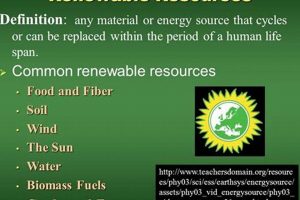
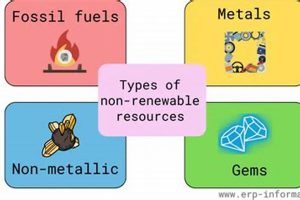
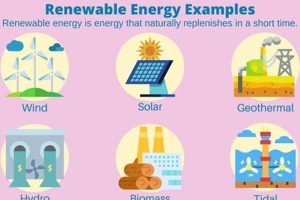
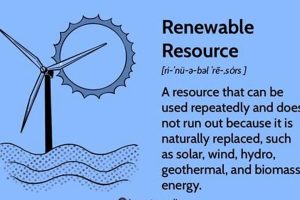
A naturally replenished energy source has the capacity to be renewed within a human lifespan. These resources are characterized by their ability to be replenished at a rate equal to or faster than the rate at which they are consumed. Examples include solar, wind, geothermal, and hydropower, as well as biomass derived from sustainable practices.
The utilization of these sustainable energy sources offers numerous advantages, encompassing environmental protection, energy security, and economic diversification. Historically, reliance on finite resources has led to geopolitical instability and environmental degradation. Shifting towards sustainable options mitigates these risks, fosters energy independence, and reduces greenhouse gas emissions, contributing to a more sustainable future and potentially stimulating economic growth through the development and deployment of related technologies.
The subsequent sections will delve into specific types, technological advancements associated with their extraction and utilization, and the policy frameworks designed to promote their adoption. The discussion will further explore the challenges and opportunities associated with integrating these sustainable options into existing energy infrastructure.
Implementing Sustainable Energy Practices
The following guidelines offer practical strategies for individuals, organizations, and policymakers to promote the adoption and efficient use of naturally replenished energy.
Tip 1: Conduct an Energy Audit: A thorough assessment of energy consumption patterns is essential. Identifying areas of inefficiency allows for targeted interventions and resource allocation toward the most impactful solutions.
Tip 2: Invest in Energy-Efficient Technologies: Replacing outdated appliances and equipment with energy-efficient alternatives, such as LED lighting and Energy Star-rated appliances, reduces overall energy demand and lowers operational costs.
Tip 3: Support Renewable Energy Development: Advocate for policies that incentivize the development and deployment of sustainable energy infrastructure, including solar farms, wind turbines, and geothermal plants. This can involve lobbying efforts, community engagement, and supporting legislation that promotes renewable energy standards.
Tip 4: Utilize Government Incentives and Rebates: Research and utilize available government incentives, rebates, and tax credits for installing naturally replenished energy systems. Many jurisdictions offer financial assistance to offset the upfront costs of adopting sustainable energy solutions.
Tip 5: Implement Smart Grid Technologies: Incorporating smart grid technologies allows for more efficient distribution and management of energy, optimizing the use of sustainable sources and reducing energy waste. Smart grids enable real-time monitoring and control of energy flows, improving grid stability and reliability.
Tip 6: Promote Education and Awareness: Educate individuals and communities about the benefits of sustainable energy and the importance of conserving energy resources. Public awareness campaigns can foster a culture of sustainability and encourage responsible energy consumption habits.
Tip 7: Prioritize Building Design: New construction and renovation projects should prioritize energy-efficient building design principles, such as passive solar heating, natural ventilation, and high-performance insulation. These design elements can significantly reduce energy consumption and reliance on conventional energy sources.
Adopting these strategies, whether at an individual, organizational, or policy level, can collectively contribute to a more sustainable energy future, reducing environmental impact and promoting energy security.
The following sections will examine potential issues of naturally replenished energies.
1. Sustainability

Sustainability is intrinsically linked to the definition of resources that are naturally replenished. The fundamental characteristic that defines these resources is their capacity to be utilized indefinitely without depletion. This stems from the inherent ability of natural processes to regenerate the resource at a rate equal to or exceeding the rate of consumption. Without this self-renewal property, a resource, regardless of its current abundance, cannot be accurately categorized as sustainable or naturally replenished. Failure to maintain sustainable practices in the extraction or utilization of such resources can lead to degradation or eventual exhaustion, thereby negating their defining characteristic.
Consider the example of biomass. While derived from organic matter and theoretically renewable, unsustainable harvesting practices, such as deforestation or excessive removal of agricultural residues, can disrupt ecosystems and diminish the long-term availability of this resource. Similarly, while hydropower is generally considered naturally replenished, changes to river systems due to dam construction, water diversion, or climate change can reduce water flow and negatively impact its power generation capacity. Therefore, the long-term viability and environmental compatibility relies on the sustainable management of these resource systems.
In summary, sustainability is not merely a desirable attribute but a defining criterion for resources described as naturally replenished. Understanding this connection is paramount for the responsible and effective utilization of these resources, ensuring their availability for future generations. Neglecting the principles of sustainability undermines the very foundation of their definition, leading to resource depletion and environmental harm.
2. Replenishment Rate

The replenishment rate serves as a critical determinant in classifying a resource under the “definition renewable resources.” This rate quantifies the speed at which a resource regenerates or recovers following its utilization. A resource’s designation as naturally replenished hinges on this rate being equal to or greater than the rate of its consumption. When consumption exceeds replenishment, the resource effectively behaves as a non-renewable entity, rendering the ‘naturally replenished’ classification inaccurate. For instance, while forests are often cited as a sustainable resource, deforestation without adequate reforestation efforts results in a net depletion of the forest cover, thereby surpassing the natural replenishment capacity and undermining its sustainability.
Variations in replenishment rates necessitate tailored management strategies. Solar energy, characterized by a nearly instantaneous replenishment, requires infrastructure capable of capturing and storing the energy for later use. In contrast, geothermal energy, while continuously available, has a comparatively slower replenishment rate in certain localized areas. Over-extraction of geothermal fluids can lead to a decline in reservoir pressure and temperature, necessitating careful monitoring and regulated extraction limits to ensure long-term sustainability. Similarly, the replenishment rate of freshwater resources, dependent on precipitation and hydrological cycles, is increasingly vulnerable to climate change, demanding integrated water resource management to mitigate scarcity.
Understanding the replenishment rate is of practical significance in assessing the true sustainability of any resource. Accurate assessment informs policies and practices aimed at balancing resource utilization with its natural regeneration capacity. Ignoring this dynamic can lead to resource degradation, environmental damage, and ultimately, the failure to achieve genuine long-term sustainability goals. Therefore, incorporating the replenishment rate as a core consideration is essential for ensuring accurate classification, effective management, and responsible utilization of naturally replenished resources.
3. Environmental Impact

Environmental impact is an intrinsic component of any discussion regarding resources that are naturally replenished. While often considered inherently benign, these resources are not devoid of environmental consequences. The extent and nature of these impacts vary significantly depending on the specific technology, the scale of deployment, and the geographical context. The imperative is to minimize adverse effects while maximizing the benefits of sustainable energy production. For example, while solar power generation itself is emission-free, the manufacturing of photovoltaic panels involves energy-intensive processes and the use of potentially harmful materials, requiring careful management and responsible disposal protocols. Wind turbines, though providing clean electricity, can pose risks to avian and bat populations, necessitating strategic placement and mitigation strategies such as radar-based deterrent systems. Hydropower, while a long-established resource, can drastically alter river ecosystems, impacting fish migration, sediment transport, and downstream water quality. Consequently, a comprehensive assessment of environmental impact is crucial for informed decision-making and responsible resource management.
Furthermore, the lifecycle environmental footprint must be considered. This includes the extraction of raw materials, manufacturing processes, transportation, installation, operation, and decommissioning or recycling phases. A seemingly environmentally benign resource, if produced or managed unsustainably, can result in a net negative environmental outcome. For instance, unsustainable harvesting of biomass for energy production can lead to deforestation, soil erosion, and biodiversity loss, negating the intended environmental benefits. Similarly, improper disposal of wind turbine blades, which are often made of composite materials, can create landfill challenges. A life cycle approach necessitates a holistic perspective, emphasizing resource efficiency, waste minimization, and responsible end-of-life management to ensure that sustainable energy solutions truly minimize overall environmental impact.
In conclusion, while the definition of naturally replenished resources often implies environmental friendliness, a nuanced understanding of their true environmental footprint is essential. Comprehensive environmental impact assessments, incorporating lifecycle considerations, are vital for guiding sustainable resource management practices and mitigating potential adverse effects. This understanding is crucial for ensuring that the transition to a sustainable energy future is achieved responsibly and effectively, minimizing unintended environmental consequences. Achieving a genuine balance between energy needs and environmental protection requires continuous innovation, rigorous monitoring, and a commitment to minimizing the environmental footprint of all energy technologies, including those considered sustainable.
4. Economic Viability

Economic viability constitutes a critical factor in the widespread adoption and sustained utilization of energy sources fitting the definition of resources that are naturally replenished. A resource, regardless of its sustainability or environmental advantages, faces implementation barriers if it cannot compete economically with conventional alternatives. The cost of energy production, including capital investments, operational expenses, and grid integration challenges, directly impacts the feasibility and attractiveness of these resources to both consumers and investors. Historically, the higher upfront costs of deploying technologies like solar and wind energy presented a significant obstacle. However, advancements in manufacturing, economies of scale, and supportive policies have led to substantial cost reductions, enhancing their economic competitiveness. For instance, the levelized cost of energy (LCOE) for utility-scale solar photovoltaic (PV) and onshore wind has decreased dramatically over the past decade, making them cost-competitive with, and in some cases, cheaper than, fossil fuel-based power generation in many regions.
The long-term economic benefits extend beyond direct energy costs. Resources fitting the definition of those that are naturally replenished can enhance energy security by reducing dependence on imported fuels, mitigating price volatility associated with finite resources, and stimulating local economic growth through the creation of jobs in manufacturing, installation, and maintenance. Furthermore, the reduced environmental externalities, such as air pollution and greenhouse gas emissions, translate into significant societal benefits, including improved public health and reduced climate change impacts. These avoided costs, while often difficult to quantify precisely, represent a significant economic advantage when considering the comprehensive societal impacts of different energy sources. Government policies, such as tax incentives, feed-in tariffs, and renewable portfolio standards, play a crucial role in leveling the playing field and incentivizing investment in these technologies, driving down costs and accelerating their deployment. For example, Germany’s Energiewende (energy transition) has spurred substantial growth in the renewable energy sector, creating numerous jobs and reducing the country’s reliance on imported fossil fuels, despite facing challenges related to grid integration and intermittency.
In summary, economic viability is not merely a desirable attribute but a fundamental prerequisite for the large-scale adoption of energy from sources that are naturally replenished. Ongoing technological advancements, supportive policies, and a comprehensive assessment of economic benefits, encompassing direct energy costs, energy security, and reduced environmental externalities, are essential for unlocking the full potential of these resources and achieving a sustainable energy future. Overcoming remaining economic barriers through continued innovation, strategic policy interventions, and efficient resource management is crucial for accelerating the transition to a low-carbon economy and realizing the full economic and environmental benefits of resources aligning with the aforementioned definition. This will ensure these energy sources are both environmentally sound and economically attractive for broad implementation.
5. Technological Advancement

Technological advancement plays a pivotal role in realizing the full potential of resources meeting the definition of those that are naturally replenished. Innovation across various domains directly impacts the efficiency, cost-effectiveness, and scalability of these resources, driving their integration into the global energy mix. The progression of technology is intrinsically linked to the viability and widespread adoption of sustainable energy solutions.
- Enhanced Energy Conversion Efficiency
Advancements in materials science and engineering have led to significant improvements in the efficiency of energy conversion technologies. For example, the development of more efficient photovoltaic cells enables solar panels to convert a greater percentage of sunlight into electricity, reducing the land area required for solar farms and lowering the cost per kilowatt-hour. Similarly, advancements in wind turbine blade design and generator technology have increased the energy capture rate of wind turbines, enhancing their overall performance. These improvements directly contribute to the economic competitiveness of these technologies.
- Improved Energy Storage Solutions
One of the primary challenges associated with resources meeting the definition of those that are naturally replenished, such as solar and wind, is their intermittent nature. Technological progress in energy storage solutions, including lithium-ion batteries, flow batteries, and pumped hydro storage, is crucial for addressing this challenge. These technologies enable the storage of excess energy generated during peak production periods for use during periods of low production or high demand. Improved energy storage enhances grid stability, reduces reliance on fossil fuel-based backup generation, and increases the overall reliability of naturally replenished energy systems.
- Smart Grid Technologies and Grid Integration
The integration of resources fitting the definition of naturally replenished energy into existing power grids requires sophisticated smart grid technologies. These technologies enable real-time monitoring and control of energy flows, optimizing the distribution of naturally replenished energy and enhancing grid stability. Smart grids utilize advanced sensors, communication networks, and control algorithms to manage the variability of sustainable energy sources and ensure a reliable power supply. Furthermore, advancements in grid management software facilitate the integration of distributed generation sources, such as rooftop solar panels, into the grid, enabling greater participation of consumers in the energy market.
- Advanced Materials for Infrastructure
The durability and longevity of naturally replenished energy infrastructure are critical for ensuring its long-term economic viability. Advancements in materials science have led to the development of more durable and weather-resistant materials for wind turbines, solar panels, and geothermal plants. These materials reduce maintenance costs, extend the lifespan of the infrastructure, and improve its overall performance in harsh environmental conditions. For example, the development of corrosion-resistant alloys for offshore wind turbines enables their deployment in more challenging marine environments, expanding the availability of wind energy resources.
These technological advancements collectively contribute to the increased efficiency, reliability, and economic competitiveness of sustainable energy technologies. Continuous innovation in these areas is essential for accelerating the transition to a low-carbon economy and realizing the full potential of resources meeting the definition of those that are naturally replenished. Further investment in research and development, coupled with supportive policies, will drive continued progress and enable the widespread adoption of sustainable energy solutions, fostering a more sustainable and secure energy future.
6. Resource Diversity
Resource diversity, in the context of resources fitting the definition of those that are naturally replenished, refers to the strategic utilization of a variety of sustainable energy sources to enhance energy security, grid stability, and overall system resilience. This diversification serves as a critical component in mitigating the inherent limitations associated with relying on any single energy resource. The variable nature of solar irradiance and wind speeds, for example, necessitates a diverse portfolio of naturally replenished sources, potentially including geothermal, hydro, and biomass, to ensure a consistent and reliable energy supply. A direct consequence of this diversified approach is the reduced vulnerability to localized weather patterns, seasonal variations, and unforeseen disruptions affecting individual resource availability. For instance, a region heavily reliant on hydropower could face significant energy shortfalls during periods of drought, whereas a diversified system incorporating solar, wind, and geothermal would be better positioned to weather such challenges. Germany’s energy transition, or Energiewende, exemplifies this principle, as it pursues a diverse mix of sustainable resources to reduce reliance on any single source and to bolster its energy security.
The practical significance of resource diversity extends beyond mitigating supply-side risks. A diversified portfolio of resources fitting the definition of those that are naturally replenished can also optimize grid management and reduce transmission bottlenecks. Geographically distributed generation from a variety of sources, such as rooftop solar, community wind projects, and localized geothermal plants, can reduce the need for long-distance transmission lines, minimizing energy losses and enhancing grid resilience. Furthermore, the integration of diverse energy sources can create synergies and opportunities for optimizing energy storage solutions. For example, excess solar power generated during peak daylight hours can be used to pump water to higher elevations for pumped hydro storage, which can then be released to generate electricity during periods of peak demand or low solar output. This integrated approach enhances the overall efficiency and reliability of the energy system.
In summary, resource diversity is not merely an ancillary consideration but an essential attribute of a robust and sustainable energy system reliant on resources that are naturally replenished. It enhances energy security, mitigates risk, optimizes grid management, and promotes system resilience. A strategic approach to resource diversification, tailored to the specific geographical, climatic, and economic context of each region, is paramount for unlocking the full potential of sustainable energy and achieving a secure and reliable energy future. Ignoring the importance of resource diversity can lead to vulnerabilities, increased costs, and a failure to achieve true energy independence. Therefore, policymakers, energy planners, and grid operators must prioritize resource diversity as a core principle in the planning and development of sustainable energy infrastructure.
Frequently Asked Questions About Resources with Naturally Replenished Qualities
This section addresses common questions and clarifies misconceptions regarding the defining characteristics and practical implications of energy sources considered renewable.
Question 1: What distinguishes a resource under the classification of ‘naturally replenished’ from one that is merely abundant?
The defining characteristic is not simply abundance, but the capacity for natural regeneration at a rate comparable to or exceeding the rate of consumption. A resource may be plentiful, yet if its extraction outpaces its natural replenishment, it is not genuinely renewable.
Question 2: Are resources fitting the definition of ‘naturally replenished’ inherently environmentally benign?
While often possessing lower environmental impacts than fossil fuels, resources described as naturally replenished are not without ecological consequences. Manufacturing processes, land use impacts, and disposal challenges must be considered to fully assess their environmental footprint.
Question 3: Why aren’t all nations exclusively utilizing resources that fit the description of being naturally replenished if they offer such clear advantages?
Barriers to widespread adoption include intermittency challenges, infrastructure limitations, upfront investment costs, and the need for grid modernization. Addressing these obstacles requires technological advancements and supportive policy frameworks.
Question 4: How is the rate of replenishment determined for various resources fitting the definition of being naturally replenished?
The method for determining the replenishment rate varies depending on the resource. Solar energy is based on solar irradiance; wind energy is based on weather pattern analysis; geothermal energy is based on the thermal conductivity and reservoir recharge of geothermal fields; hydropower is based on hydrological models and precipitation patterns; and biomass is based on growth rates of organic matter.
Question 5: How can the economic viability of energy derived from a source which fits the definition of naturally replenished be accurately assessed?
Economic viability assessment requires a comprehensive analysis encompassing capital costs, operational expenses, fuel costs (where applicable), grid integration charges, and environmental externality valuations. The Levelized Cost of Energy (LCOE) is a standard metric used for comparative analysis.
Question 6: Is energy from resources that fit the description of being naturally replenished always the optimal solution for all locations and energy needs?
The suitability of a particular sustainable resource is highly context-dependent. Factors such as geographical location, resource availability, grid infrastructure, and economic conditions must be carefully evaluated to determine the most appropriate and cost-effective energy solution.
In conclusion, the advantages of energy resources described as naturally replenished are clear, though their successful and sustainable implementation necessitates a thorough understanding of their defining characteristics, potential impacts, and economic considerations.
The following section will explore potential future trends.
Conclusion
This exploration has dissected the multifaceted components of the defining traits of resources that naturally replenish. The ability of these resources to renew themselves within a reasonable timeframe sets them apart from finite fossil fuels. Sustainability, replenishment rate, environmental impacts, economic viability, technological advancements, and resource diversity are all defining characteristics. A comprehensive understanding of these attributes informs sound decision-making regarding energy policy and investment. Disregarding any of these elements risks compromising the long-term effectiveness and sustainability of energy systems.
The integration of energy derived from resources fitting the definition requires continued research and development, strategic policy implementation, and a commitment to minimizing environmental footprints. The ongoing pursuit of innovation will define the future trajectory of sustainable energy. A diligent application of the principles outlined herein ensures a secure, resilient, and environmentally responsible energy future for generations to come.
![Guide to What Energy Resources Are Renewable [+Future] | Renewable Energy Solutions for a Sustainable Future | Clean & Green Power](https://pplrenewableenergy.com/wp-content/uploads/2026/03/th-516-300x200.jpg "Guide to What Energy Resources Are Renewable [+Future] Renewable Energy Solutions for a Sustainable Future | Clean & Green Power")