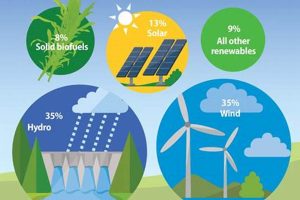
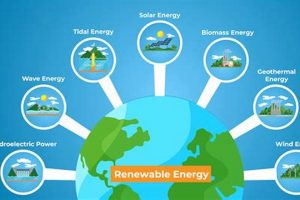
Hydropower, also known as hydroelectric power, harnesses the energy of moving water to generate electricity. This process typically involves damming a river or stream, creating a reservoir, and releasing water through turbines that are connected to generators. The mechanical energy of the water turning the turbines is converted into electrical energy. An example is the Three Gorges Dam in China, one of the most substantial installations of this type globally.
The significance of this method lies in its established technology and capacity for large-scale electricity production. It provides a reliable and dispatchable energy supply, meaning it can be adjusted to meet fluctuating energy demands. Historically, water power has been utilized for centuries, evolving from simple waterwheels for grinding grain to complex hydroelectric plants supplying power to entire regions. The benefits include reduced reliance on fossil fuels, lower greenhouse gas emissions compared to thermal power plants, and potential for flood control and water management.
Consequently, understanding the dynamics of this energy generation method is essential for evaluating future energy strategies. Its role in grid stabilization, contribution to sustainable energy portfolios, and impact on ecosystems and communities surrounding the infrastructure will be explored in further detail in subsequent sections.
Implementation Guidelines
The following guidelines offer practical considerations for leveraging hydroelectric power effectively and responsibly.
Tip 1: Site Selection: Conduct thorough environmental impact assessments before commencing construction. Identify sites with sufficient water flow and minimal ecological disruption. For example, consider run-of-river projects that divert water without creating large reservoirs.
Tip 2: Technological Optimization: Employ advanced turbine designs to maximize energy conversion efficiency. Variable-speed turbines and pumped storage systems can improve grid integration and energy storage capabilities.
Tip 3: Ecosystem Management: Implement fish passage systems to mitigate the impact on aquatic life. Maintain minimum water flows downstream to sustain river ecosystems. Consider restoring degraded habitats in the surrounding areas.
Tip 4: Community Engagement: Consult with local communities throughout the planning and construction phases. Address concerns regarding displacement, water rights, and economic impacts. Ensure that benefits are shared equitably.
Tip 5: Regulatory Compliance: Adhere to all applicable environmental regulations and permitting requirements. Develop a monitoring program to track environmental performance and identify potential issues.
Tip 6: Infrastructure Maintenance: Implement a comprehensive maintenance program to ensure the long-term reliability and safety of the hydroelectric facility. Regular inspections and repairs can prevent costly breakdowns and environmental hazards.
Tip 7: Grid Integration: Coordinate with grid operators to ensure stable and reliable electricity supply. Utilize advanced control systems to manage water releases and optimize power generation.
Proper application of these guidelines can enhance the viability of hydroelectric power, promoting sustainable energy development while minimizing negative consequences.
The subsequent sections will address common challenges and emerging technologies in the field.
1. Established Technology

The prominence of hydroelectric power as a primary renewable energy source is intrinsically linked to its mature technological base. This “Established Technology” foundation, developed over a century, offers several crucial advantages. First, the underlying principles and engineering practices are thoroughly understood, resulting in predictable performance and lower operational risks. Second, standardized components and construction methods exist, facilitating efficient project development and maintenance. The widespread use of Francis, Kaplan, and Pelton turbines, for example, demonstrates this standardization. The consequence is a reduced technological uncertainty, leading to greater investor confidence and wider adoption.
Further, the “Established Technology” status enables continuous improvement and refinement. Modern hydroelectric facilities incorporate advanced materials, digital control systems, and predictive maintenance techniques, enhancing efficiency and extending lifespan. For instance, concrete dams built in the early 20th century are being retrofitted with sensors and monitoring systems to detect structural weaknesses and prevent failures. This evolution leverages the existing knowledge base while integrating contemporary innovations, securing hydropower’s competitive edge.
In summary, the reliance on “Established Technology” has cemented hydropower’s position as the most significant renewable energy source. This foundation fosters reliability, reduces risk, and supports ongoing enhancements. While newer renewable technologies continue to advance, the well-defined and continually refined practices of hydroelectric power generation ensure its continued relevance in the global energy landscape.
2. Scalability

The prominence of hydropower as the most significant renewable energy source is inextricably linked to its intrinsic scalability. This characteristic allows hydroelectric facilities to be tailored to a wide range of power demands and geographical contexts, thereby contributing to its global dominance.
- Capacity Variation
Hydroelectric projects exhibit a broad range in power generation capacity, from small-scale run-of-river systems providing electricity to isolated communities to massive dam complexes serving entire regions. This adaptability is exemplified by projects like the Itaipu Dam, a multi-gigawatt facility, and smaller, localized installations that minimize environmental disruption while meeting local energy needs. The ability to adjust capacity to meet specific demands is a key factor in hydropower’s widespread adoption.
- Infrastructure Adaptability
The infrastructure associated with hydropower can be adapted to different geographical conditions and environmental constraints. Dam construction can range from large concrete structures to smaller, less invasive diversion systems. Pumped storage facilities, which act as large-scale batteries by pumping water uphill to be released for power generation later, further enhance scalability by decoupling energy production from immediate water flow. These adaptations allow for the exploitation of diverse water resources, solidifying hydropower’s role in various energy portfolios.
- Incremental Expansion
Hydroelectric facilities offer the potential for incremental expansion as energy demands increase. Additional turbines or generators can be added to existing dams, increasing power output without requiring entirely new construction. This phased approach allows for efficient capital allocation and minimizes upfront investment risks. The expansion of the Grand Coulee Dam, where power generating capacity was iteratively increased over several decades, serves as a prime example.
- Grid Integration
The scalability of hydropower extends to its integration with existing power grids. Large hydroelectric plants can provide base-load power, while smaller facilities can supplement regional grids and enhance grid stability. Pumped storage systems, in particular, play a crucial role in balancing intermittent renewable sources like solar and wind. This grid compatibility ensures that hydroelectric power can effectively contribute to diverse energy systems.
In conclusion, the various facets of scalability inherent in hydropower have directly facilitated its establishment as the foremost renewable energy source. Its capacity variation, infrastructure adaptability, potential for incremental expansion, and grid integration capabilities allow it to address a wide spectrum of energy needs, reinforcing its significance in the global energy transition.
3. Reliability

The status of hydropower as the foremost renewable energy source is fundamentally linked to its demonstrated reliability. This dependability stems from the predictable nature of water flow, the established engineering practices in dam construction and turbine operation, and the inherent dispatchability of hydroelectric power plants. Unlike some renewable sources that are intermittent and dependent on weather conditions, hydroelectric facilities can provide a consistent and controllable energy supply, making them a crucial component of grid stability. The availability of water resources, while subject to seasonal variations and long-term climate patterns, is generally more predictable than wind speeds or solar irradiance, allowing for better resource planning and energy forecasting.
The reliability of hydroelectric power is particularly evident in its capacity to provide baseload power, meeting the continuous minimum electricity demand of a grid. In regions such as the Pacific Northwest of the United States and Scandinavia, hydropower has historically served as a stable and readily available energy source, supporting industrial development and residential consumption. Furthermore, pumped storage hydropower enhances reliability by acting as a large-scale energy storage system, allowing for the capture of surplus energy during periods of low demand and its release during peak demand. This characteristic is critical for integrating variable renewable sources like solar and wind into the grid, ensuring a stable and continuous power supply. However, the reliability of hydropower is contingent on proper maintenance and infrastructure management, as well as adaptation to evolving climatic conditions.
In summary, the reliability of hydropower has been a decisive factor in its establishment as the leading renewable energy source. The predictability of water flow, the ability to provide baseload power, and the potential for pumped storage contribute to grid stability and energy security. While challenges related to environmental impacts and climate change exist, the inherent reliability of hydropower ensures its continued importance in the global energy transition. This understanding underscores the practical significance of prioritizing infrastructure maintenance, optimizing operational practices, and adapting to changing hydrological conditions to maintain the dependability of this vital energy source.
4. Storage Potential

The integration of energy storage solutions with hydroelectric facilities significantly enhances the value and versatility of this dominant renewable energy source. The “Storage Potential” inherent in hydropower contributes directly to grid stability, improved efficiency, and increased flexibility in meeting fluctuating energy demands. Effective utilization of this potential is crucial for optimizing the performance and sustainability of hydroelectric power generation.
- Pumped Storage Hydropower (PSH)
Pumped Storage Hydropower (PSH) involves pumping water from a lower reservoir to an upper reservoir during periods of low energy demand, typically at night, using surplus electricity from other sources. This stored water is then released through turbines to generate electricity during peak demand periods. PSH acts as a large-scale energy storage system, providing rapid response and grid balancing services. Examples include the Bath County Pumped Storage Station in Virginia, USA, and the Dinorwig Power Station in Wales, UK. These facilities demonstrate the capability to efficiently store and release large amounts of energy, contributing to grid stability and reducing reliance on fossil fuel peaker plants.
- Reservoir Management Optimization
Effective reservoir management optimizes water releases to balance power generation, irrigation, flood control, and environmental needs. By strategically managing water levels and release rates, hydroelectric facilities can maximize energy production while minimizing ecological impacts. Real-time monitoring and forecasting systems enable operators to predict water inflow and demand, allowing for optimized water management. The Tennessee Valley Authority (TVA) in the United States provides an example of a comprehensive water management system that integrates hydropower generation with other water resource objectives. Improved reservoir management enhances the overall efficiency and sustainability of hydroelectric power generation.
- Hybrid Storage Systems
Hybrid storage systems combine hydroelectric power with other energy storage technologies, such as batteries or compressed air energy storage (CAES), to enhance grid services and optimize energy dispatch. Integrating batteries with hydroelectric facilities allows for fast response to grid fluctuations and improved voltage and frequency control. CAES systems store energy by compressing air into underground caverns, which can then be released to drive turbines. An example is the Huntorf CAES plant in Germany. The integration of these hybrid systems allows for enhanced grid stabilization and optimized use of hydropower resources.
- Virtual Storage with Grid Interconnection
Grid interconnection creates virtual storage by allowing hydroelectric facilities to exchange power with other regions. During periods of low demand in one region, surplus hydropower can be exported to another region with higher demand, effectively storing energy in the form of reduced fossil fuel generation. Grid interconnection enhances overall system efficiency and reduces the need for additional energy storage capacity. The European interconnected grid, for example, allows hydroelectric power from the Alps and Scandinavia to be shared across the continent, providing a flexible and reliable energy supply.
In conclusion, the “Storage Potential” associated with hydroelectric power, whether through pumped storage, optimized reservoir management, hybrid systems, or grid interconnection, significantly enhances its role as the predominant renewable energy source. These capabilities provide grid stability, improve efficiency, and enhance the flexibility of hydroelectric facilities, ensuring their continued importance in meeting global energy demands while minimizing environmental impacts. The continued development and integration of these storage solutions are crucial for maximizing the benefits of hydroelectric power in the evolving energy landscape.
5. Geographical Limitations

The deployment of hydroelectric power, despite its position as the most significant renewable energy source globally, is fundamentally constrained by geographical factors. The viability of hydroelectric facilities depends on the presence of substantial water resources, suitable topography for dam construction and reservoir creation, and favorable geological conditions to ensure structural stability. These preconditions restrict the geographic distribution of viable hydroelectric sites. Regions lacking sufficient rainfall, significant river systems, or appropriate terrain are inherently limited in their capacity to harness hydroelectric power. The unequal distribution of these resources around the globe directly influences where large-scale hydroelectric projects can be realistically implemented. For instance, while mountainous regions with abundant rainfall, such as the Himalayas and the Andes, present ideal conditions for hydropower development, arid or flat regions are severely limited.
The implications of these geographical constraints are multifaceted. Countries with limited access to suitable hydroelectric sites may need to rely on alternative energy sources, potentially increasing their dependence on fossil fuels or other renewable technologies that may have different environmental and economic implications. Furthermore, the concentration of hydropower potential in specific regions can lead to geopolitical considerations, particularly regarding water resource management and cross-border energy agreements. The Mekong River, for example, flows through several Southeast Asian countries, leading to complex negotiations and potential conflicts over dam construction and water allocation. Understanding these geographical limitations is crucial for informed energy planning and decision-making, as it highlights the need for diversified energy portfolios and sustainable resource management strategies.
In conclusion, the inherent geographical limitations associated with hydroelectric power significantly influence its potential as the dominant renewable energy source. While hydropower offers numerous advantages, including dispatchability and storage capabilities, its dependence on specific geographical conditions restricts its global applicability. Recognizing these constraints is essential for developing realistic energy strategies, promoting regional cooperation, and exploring alternative renewable technologies to meet the diverse energy needs of different regions. These limitations, therefore, necessitate a balanced approach to energy policy, acknowledging the regional variations in resource availability and prioritizing sustainable practices to minimize environmental impacts.
Frequently Asked Questions
The following addresses common inquiries concerning hydroelectric power, often cited as the largest renewable energy source. These responses provide clear and concise information based on current understanding and established practices.
Question 1: Is hydroelectric power truly sustainable given environmental concerns?
While classified as renewable due to its reliance on naturally replenishing water cycles, sustainability is not absolute. Large-scale dams can significantly alter river ecosystems, displace communities, and contribute to methane emissions from reservoirs. Sustainable hydroelectric development requires careful site selection, environmental impact assessments, and mitigation measures.
Question 2: What factors determine the power output of a hydroelectric facility?
Power output is primarily determined by two factors: the head (the height difference between the water surface and the turbine) and the flow rate (the volume of water passing through the turbine per unit of time). Higher head and greater flow rates result in increased power generation.
Question 3: How does pumped storage hydropower contribute to grid stability?
Pumped storage systems operate as large-scale energy storage devices. During periods of low electricity demand, water is pumped from a lower reservoir to an upper reservoir, storing energy. During peak demand, this water is released to generate electricity, providing rapid response and grid balancing services. This helps integrate intermittent renewable sources like solar and wind.
Question 4: Are there alternative hydroelectric technologies that minimize environmental impact?
Yes, run-of-river hydroelectric projects divert a portion of a river’s flow through a turbine without creating a large reservoir. These projects typically have a smaller environmental footprint compared to traditional dam projects but may also have lower power generation capacity.
Question 5: How does climate change affect hydroelectric power generation?
Climate change can significantly impact hydroelectric power generation through altered precipitation patterns, increased frequency of droughts, and changes in snowmelt runoff. These variations can affect water availability, reducing power output and increasing the risk of operational disruptions. Adaptation strategies are necessary to ensure the long-term viability of hydroelectric facilities.
Question 6: What is the economic lifespan of a hydroelectric dam?
With proper maintenance and upgrades, a hydroelectric dam can have an economic lifespan of 50 to 100 years or even longer. However, factors such as sedimentation, structural degradation, and changes in water flow can affect its long-term performance and necessitate rehabilitation or decommissioning.
These FAQs provide a foundational understanding of the complexities and considerations associated with hydroelectric power as the dominant renewable energy source. Careful evaluation of environmental impacts, technological advancements, and climate change effects are crucial for ensuring its sustainable and reliable contribution to global energy needs.
The following section will examine future trends and innovations in the field of hydroelectric power.
Concluding Remarks
Hydroelectric power, acknowledged as the largest renewable energy source, maintains a critical role in global electricity generation. This exposition has examined its established technology, scalability, reliability, storage potential, and geographical limitations. These attributes collectively define its prominence and also highlight areas requiring careful consideration for sustained responsible development.
As the global community navigates the complexities of energy transition, recognizing the multifaceted nature of hydroelectric power is paramount. Continued advancement in technology, responsible environmental stewardship, and comprehensive integration with other renewable sources are essential. These considerations will dictate the long-term viability and societal benefit derived from this significant energy resource.